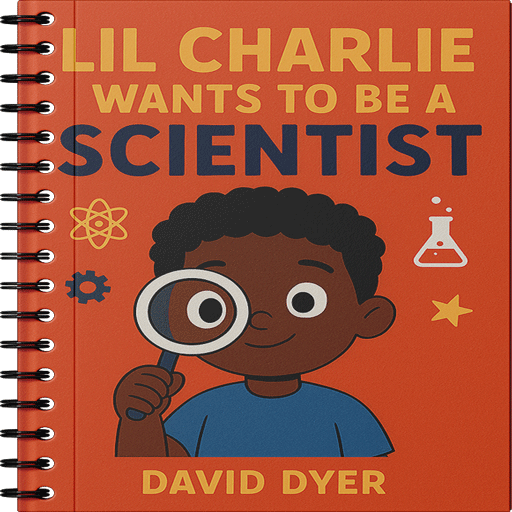

Little Charlie Wants to Be a Scientist
Little Charlie wants to be a scientist. But he keeps making glorious messes instead.
His rocket goes splat. His volcano erupts all over the kitchen table. His wind vane blows apart. And yet, Charlie never stops grinning. Because every flop, every spill, and every "uh oh" teaches him something new. That is the heart of this book.
And every single page comes alive with playful illustrations. From Charlie's wide eyes watching ants march to Maya's giggles as red foam spills everywhere, the pictures tell half the story. You will see the splat, the sploosh, the wobbly wind vane, and the proud grin of a boy who just won the science fair. No page is left without color, without movement, without a little hidden detail for sharp eyes to spot. The art and words dance together like best friends.
At its core, Little Charlie Wants to Be a Scientist shows young readers that science is not about getting things right the first time. It is about asking questions, trying again, and finding joy in the unexpected. The book is written for curious kids ages 4 to 8 who love to wonder "why" and parents, teachers, and grandparents who want to cheer them on. It is a story for anyone who believes a kitchen volcano is not a disaster. It is an experiment.
Here is how David Dyer brings this story to life. He uses bouncy sounds like splat and sploosh. He fills sentences with giggles and gasps. He lets Charlie fail with a laugh instead of a frown. The words hop off the page like a jumping bean. Short sentences. Playful questions. Moments that make a child shout "Again!" This is not a lecture about science. It is an invitation to dive into the mess and discover something wonderful.
So open this book with a young reader. Ask your own big question. And remember, even a spilled cup of water can be a discovery.